We Raised $22M to Build the Financial Infrastructure Healthcare Revenue Needs
What this funding is for, what we've learned, and what we're building next.
The market mechanism
U.S. providers lose $125 billion in earned revenue every year. The reason is structural.
Healthcare providers are losing revenue at the systems level. The care is delivered. The billing is submitted. But between the claim and the bank account, financial data moves through a network of disconnected systems that were never designed to share information with each other.
A single claim moves through an electronic health record, a billing platform, a clearinghouse, a payer portal, and eventually a bank account. Each system touches a portion of the story. None of them tell the whole story. The result is that providers can see revenue is missing, but can't reliably explain where it went or why.
The underlying issue is structural. Financial data is scattered across systems that were never designed to connect, and revenue cycle teams have had to build their operations around that reality without having the infrastructure to change it.
"We spent our first year working alongside clinics as fractional CFOs for dozens of practices. What we consistently found wasn't a staffing problem or a workflow problem, it was a data infrastructure problem. Financial information was scattered across multiple systems, and no one could see the full lifecycle of a claim."
Eliana Berger, Co-Founder & CEO
The denial architecture
Diagnosing denials at scale.
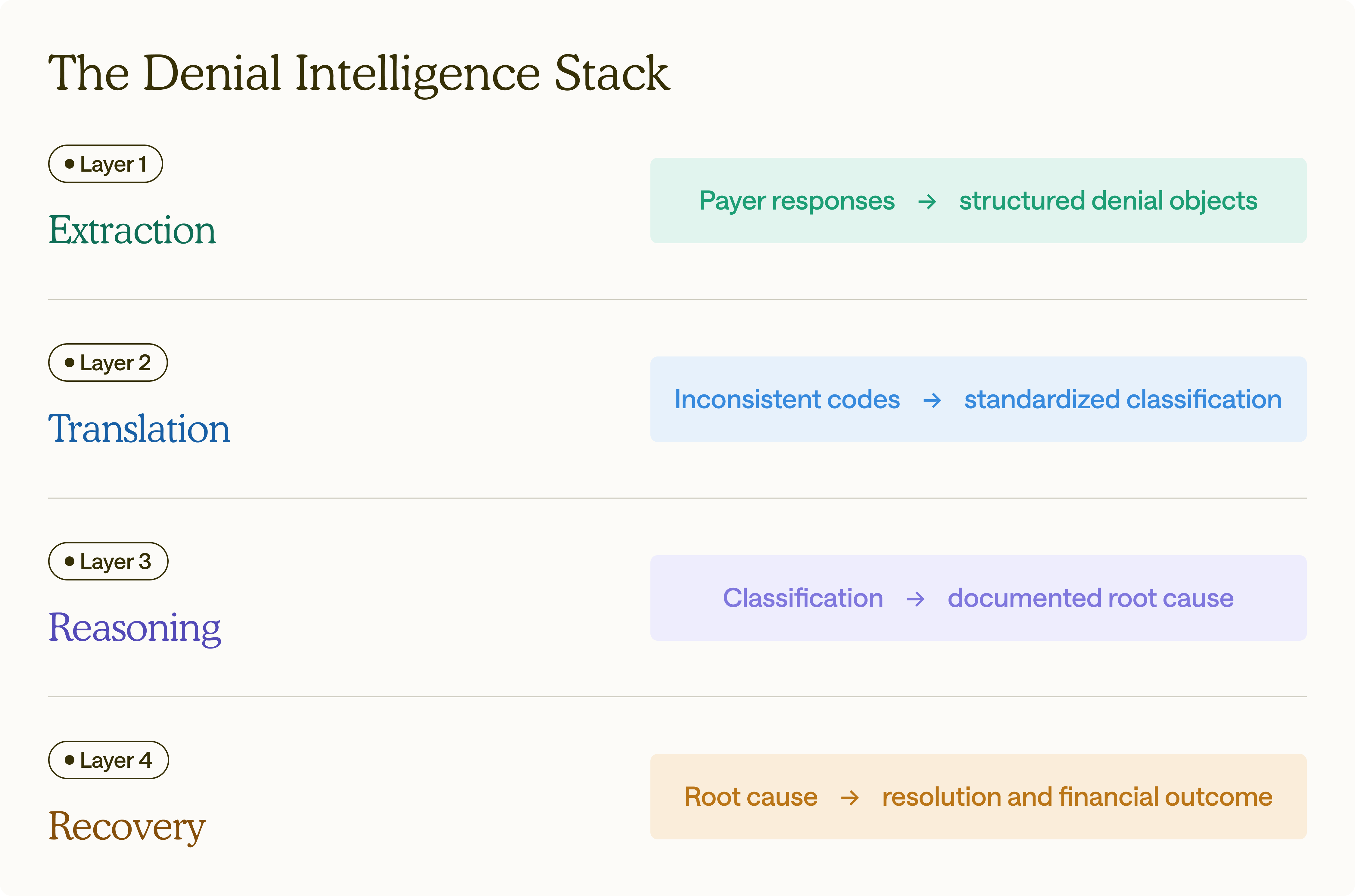
When a claim is denied, the event generates a signal. That signal encodes information about what broke down: a documentation gap, an authorization failure, a payer policy shift, a workflow misconfiguration. But because denial data moves through multiple disconnected systems: ERA, EHR, PM, clearinghouse, and BI. The signal rarely arrives intact.
Finance teams see cash slowdowns and forecast variance. Revenue cycle teams see growing queues and repeated denial categories. Both groups are observing the same underlying problem from different vantage points. What's missing is the infrastructure that connects these signals into a coherent explanation.
We call this the Denial Architecture problem. Most organizations don't have a system that converts operational denial signals into structured financial intelligence. As a result, revenue operations stay reactive, recovering what can be recovered, explaining variance after the fact, and cycling through the same denial categories without ever building the controls to prevent recurrence.
What we're building
A denial intelligence and recovery infrastructure layer, operating inside existing systems.
Joyful Health connects fragmented revenue cycle systems into a single structured foundation. We map the relationships between clinical encounters, claims, remittance data, payer rules, and bank deposits so that organizations can see the full lifecycle of every claim, many of them for the first time.
Recent advances in AI have made this possible at a scale that wasn’t feasible before. Our platform uses AI to reconstruct the full timeline of every claim, surface where breakdowns occur, and identify the highest-value recovery opportunities. Our technology identifies where claims break down, investigates denials and collects unpaid insurance claims. Our expert billers take it from there: investigating denials, filing appeals, resubmitting documentation, following up with payers, and documenting root cause at every step.
To date, we’ve processed more than $1.4 billion in transactions and delivered a 95%+ resolution rate across a wide range of specialties.
"You can't automate what you can't see, and you can't see what's scattered across incompatible systems. Advances in AI have made it possible, for the first time, to take that data and turn it into something clean, structured, and actionable at scale."
Warren Green, Co-Founder & CTO
We’re not a replacement for existing revenue cycle operations. We operate inside them, working alongside internal teams and within existing systems, targeting the 10–20% of claims that require the most effort and generate the most financial noise.
What changes and what doesn't
This funding accelerates what we've already built. The model stays the same.
We'll use this round to expand our team, accelerate product development, and support growing demand from enterprise healthcare organizations. More claims processed. More specialties served. More structured denial intelligence fed back into prevention.
What doesn't change: our model. Our business is built around the value we deliver. We’re not incentivized to report activity; we’re incentivized to drive recovery. We don’t lead with dashboards and stop at visibility. We investigate and execute. We document root cause so that prevention is measurable, not assumed. And we operate without disrupting the revenue cycle infrastructure already in place.
Looking ahead, this round gives us the resources to pursue the larger opportunity we’ve always been building toward: giving healthcare organizations the financial infrastructure to understand and control their own revenue at the system level. That means more complete claim lifecycle traceability, deeper payer intelligence, and prevention loops that reduce denial recurrence across the full portfolio, not just the claims we’ve already touched.
The goal has always been the same: turn denial volatility into designed financial control.
We're grateful to CRV and our existing investors for their continued belief in this infrastructure, and to the revenue cycle and finance leaders who have let us operate inside their organizations and trusted us with the hardest claims.
If your organization is managing denial backlog, forecast variance, or aged AR that isn't moving, we'd be glad to show you how we work.
About Joyful Health
Joyful Health provides a claim-level denial intelligence and recovery infrastructure layer for insurance-driven healthcare organizations. Operating inside existing revenue operations, Joyful investigates, resolves, and documents high-complexity denials, turning revenue volatility into structured financial control.
