No physician would prescribe treatment before making a diagnosis. Yet that's exactly how many revenue cycle decisions get made today. A rising RCM denial rate, slower cash, or an overwhelmed team all look like problems that need immediate action. But symptoms aren’t diagnoses.
And when the diagnosis is wrong, the solution rarely works.
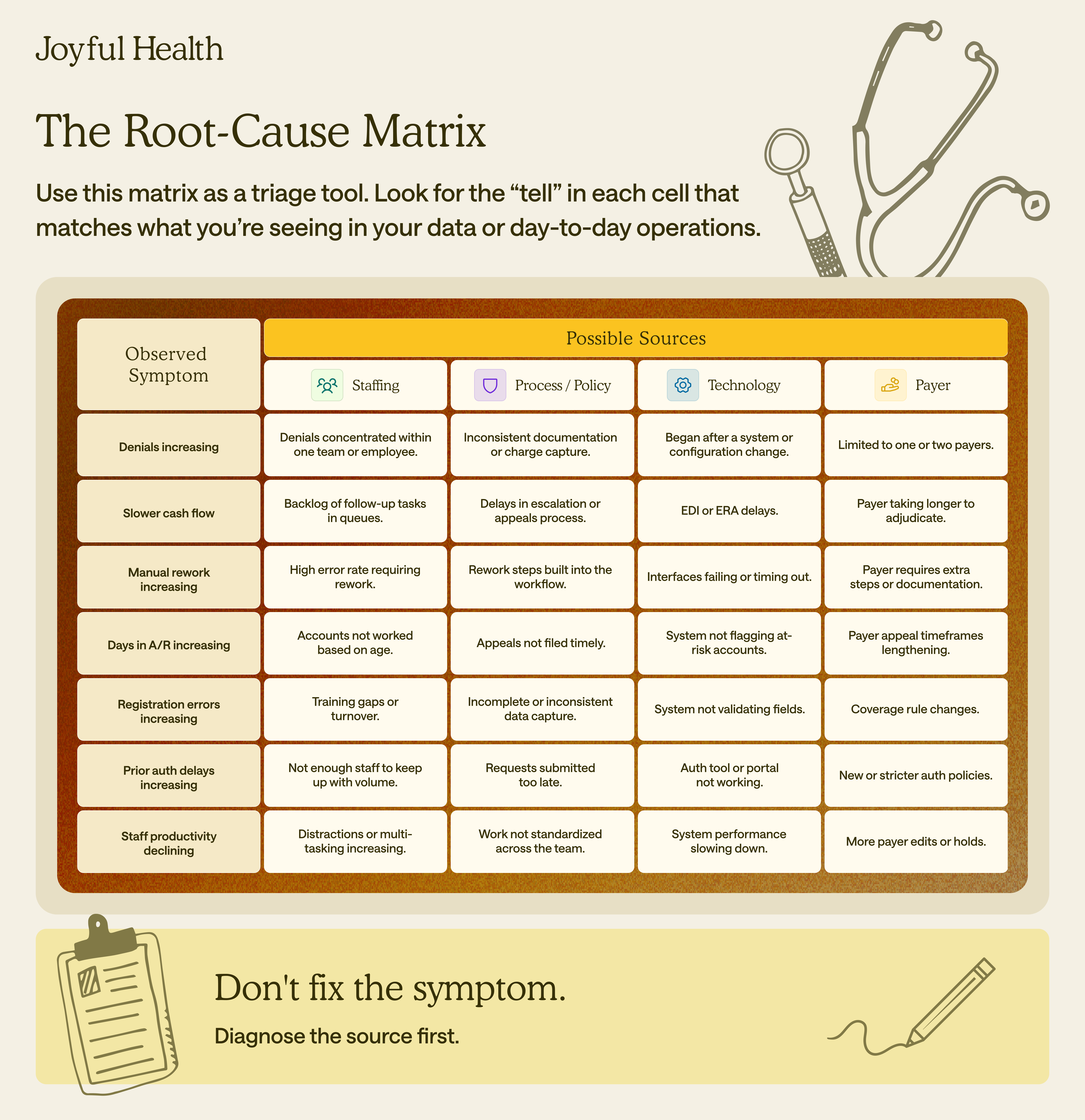
With this in mind, Joyful Health’s RCM Center of Excellence team designed a Root-Cause Matrix to serve as a triage guide for exactly this kind of moment. With this tool, healthcare RCM teams can analyze their symptoms and more accurately diagnose them before assigning the fix.
The RCM Root-Cause Matrix
.png)
How to use the matrix
Start with the symptom flagged on your dashboard, then work through it in this order:
- Read the full row before acting on one column. More than one tell showing up at once is the real signal.
- Check your own baseline first. Rule out what changed internally before blaming the payer or the system.
- Look for a second symptom. The clearest root causes are never just a single tell.
- Route it to the right owner. Eligibility to front desk, auth to the authorization team, coding to coding or billing, enrollment to credentialing.
- Come back to it. Last quarter's staffing issue can be this quarter's tech issue.
What is really driving your RCM denials
Staffing
When staffing is the real root cause, it rarely announces itself as an obvious staffing problem. It shows up in the data first:
- Clean claims rate drops after a staffing change, before anyone's flagged it
- Unworked denials and A/R follow-up start piling up because new claims keep getting prioritized over what's already denied
- Error rates widen between newer and tenured staff
Where this gets misdiagnosed: a missing-info denial reads as a staff mistake, when really, the field was filled out correctly, and the system's mapping to the payer file is what's off.
Process / Policy
Process/policy is the one no one thinks to check first, because it doesn’t feel like anyone’s fault; until you realize the rule itself is the problem, not the person following it.
- Legitimate same-day, multi-provider claims flagged as duplicates
- Aging buckets too broad to catch what a faster-paying payer would flag earlier
- Errors clustering in the billing, rendering, or supervising provider fields
Where this gets misdiagnosed: retraining staff on submission when it's really the payer's auto-adjudication logic doing the flagging.
Technology
Technology-driven root causes hide well, because they produce the exact same denial codes as staffing or payer issues would. The actual signal to trust is in the system data, not the denial reason itself:
- Gap between scheduled encounters and what's actually billed
- Rejections clustering at the scrubber
- Field-mapping mismatch to the 837/CMS-1500
Where this gets misdiagnosed: taking "missing information" at face value instead of checking upstream, like a provider's taxonomy code in the NPI registry.
Payer
Payer-driven root causes are the hardest to prove because payers rarely announce changes clearly. The tell isn't a notification; it’s a shift against your own baseline:
- Denial rate moves off its established rate for a specific payer
- Prior auth denial on a service that doesn't need it, paired with a request for a W-9
- No remittance well past the payer's contractual window
Where this gets misdiagnosed: assuming the payer changed something when you changed it first, like a new state, a new provider, or a new service.
Two symptoms, one root cause
A frequent oversight at most healthcare organizations is not looking past the denial code. A missing information denial reads as a staff mistake. A duplicate denial reads as a submission error. A prior authorization denial reads as an authorization gap. In each case, treating the surface-level code as the root cause sends the team down the wrong path, and the claim still doesn't get paid.
A prime example of this is a denial for missing prior authorization on a service that never actually required authorization. Taken alone, that denial sends teams chasing an authorization that was never attainable, because it was never needed. But if you pair that denial with a request for a W-9, something different comes into view: the provider is likely out of network, and the payer is really asking for a single case agreement, not proof of authorization. Two symptoms, read together, point to one specific and very fixable root cause.
This is the pattern that most self-diagnoses miss, because it requires looking at more than one signal at a time. It's also the layer Joyful Health is built to surface automatically, connecting claim-level signals across systems, so the root cause shows up before your team has spent a week chasing the wrong one.
Keep the matrix on hand for the next spike
Download the RCM Root-Cause Matrix and skip the guesswork the next time a symptom shows up on your dashboard. Want to learn more about how Joyful Health's expert RCM team identifies denial root causes and helps prevent them in the future? Contact us.