The most expensive mistakes in the healthcare revenue cycle don’t usually come from making the wrong decision; they come from solving the wrong problem.
Here’s a common scenario that plays out: A CFO watches denials climb, assumes it was the technology that failed, and signs a new contract before ever digging into the data to understand the real root cause.
Three months later, the vendor was implemented, the invoice was paid, and the denial rate hasn't moved, because the problem was never the vendor. It was one payer that had quietly changed how they adjudicated a specific code.
And here’s the kicker: A new vendor takes a quarter to stand up. Headcount takes months to hire, train, and get productive. Neither one touches a problem it wasn't built to fix, and by the time that's obvious, you've spent the budget and the quarter.
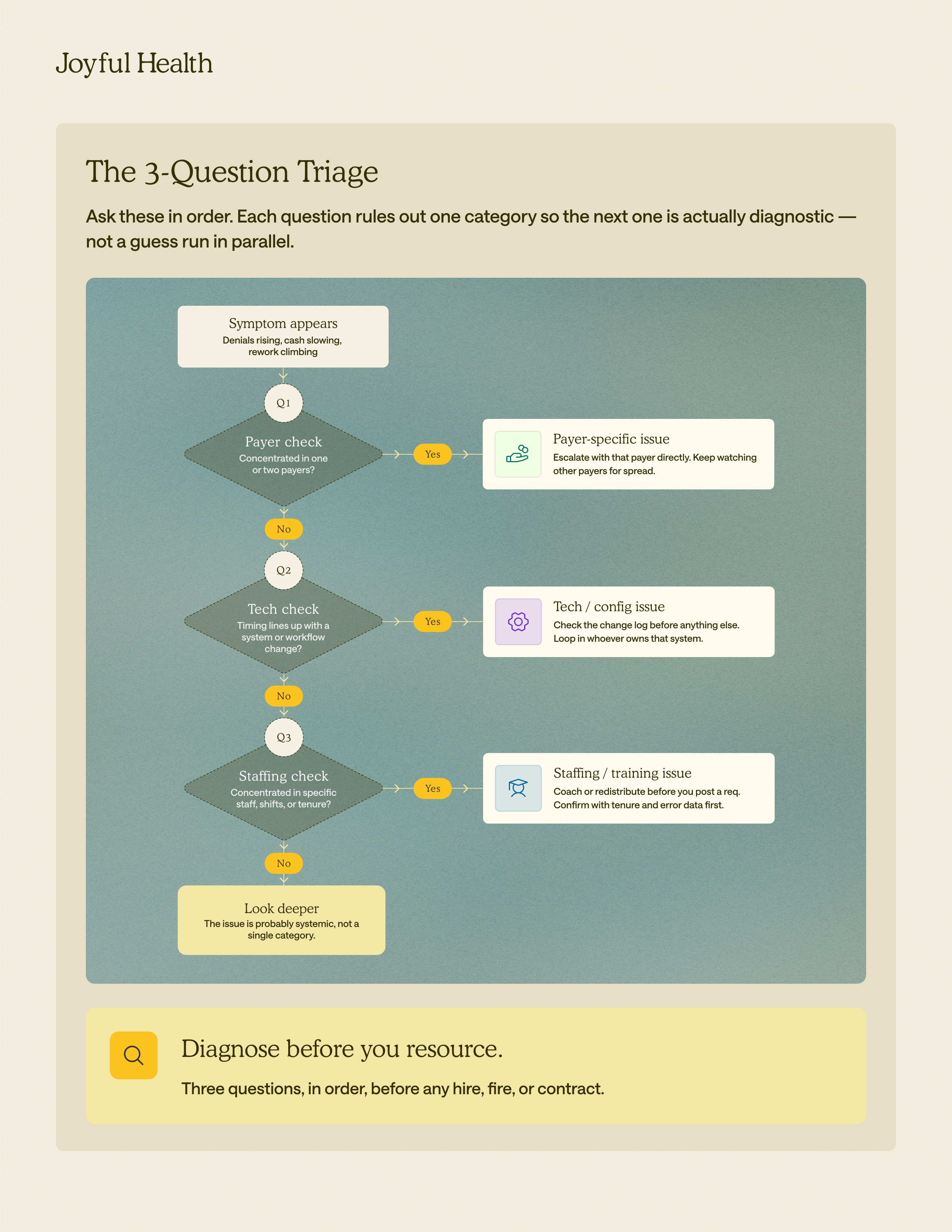
Before any of these decisions get made, RCM leaders need a way to diagnose RCM problems accurately, and a simple three-question framework can guide that process.
Start here: what's actually signaling the problem?
Before getting to the three checks, there’s a question that lies underneath the question, and skipping it is how teams end up addressing the right signals with the wrong solutions.
Start by digging deeper into the indicators. What signals identified that something was wrong? Was it a data point? A feeling? Staff pushing back? Cash not showing up when expected? A hard time keeping up with volume? The answer determines everything downstream.
If staff are the ones raising the alarm, the next question is to understand why: overwhelmed, under-resourced, unclear on expectations? That points toward process or people.
If it's a feeling that visibility is missing, the next question is about what visibility you do have and where specifically it's missing. If it's a hard number like denials or cash flow, that's where the three fastest checks below come in.
Industry experts treat all of these as real signals, including the ones that aren't a number on a dashboard.
3 questions that diagnose RCM problems fast
Let’s say that what’s signaling the problem is a hard number — a denial rate, days in A/R climbing, or another red blip on a dashboard. With these three checks, order matters. Each one has to rule out a category before the next question can actually be diagnostic. In the below example, denial rate is the metric being challenged.
.png)
Check 1, Payer: Is the denial rate concentrated in one or two payers, or spread evenly across all of them?
Compare each payer's current numbers against their own historical trend. If nothing's changed on the provider end and a specific payer's numbers move off their normal baseline, the issue is likely payer-specific.
- Concentrated → payer-specific issue. Escalate directly; keep watching whether it spreads.
- Spread evenly → not a payer-specific issue. Move to the next check.
Check 2, Tech: Did the timing of the denial rate increase line up with a system, integration, or workflow change?
Start by analyzing clean claims rate. Frequent rejections point to how claims are being filled out, how fields map into the billing system, or the health of the clearinghouse integration. Remittances that aren’t coming back electronically usually mean an EDI enrollment issue.
- Yes, timing lines up → tech/configuration issue. Check the change log before anything else.
- No → move to the next check.
Check 3, Staffing: Is the denial rate concentrated in specific staff, shifts, or tenure, or is there an even distribution of denials across the team?
Review denial categorization. A spike in eligibility denials often points to a skipped eligibility check; a spike in prior auth denials often traces back to a missed authorization step. There's a thin line between staffing and tech here — is the tool doing what it's supposed to do, or is this user error? Both can produce the same denial pattern.
- Concentrated → staffing/training issue.
- Even distribution → none of the three possible problem areas isolate a specific root cause. The problem is probably process, not a single category.
What not to do while you're triaging
Even with the right questions, there are a few ways people talk themselves out of a clean answer mid-triage. Here are some useful tips on what not to do while you’re triaging:
- Don't immediately act on the loudest signal in your data before separating it out. If one payer contract makes up the bulk of the revenue and performs well, it can completely mask how everything else is performing. In one example, an organization billing more than $88 million a year had a single contract that accounted for 80% of that revenue. While the large contract was running smoothly, underneath it, the remaining 20% was hemorrhaging denials, causing millions left on the table. This was essentially invisible because the dominant contract was carrying the average.
The same thing happens with an over-represented CPT code, provider, or facility: pull the biggest one out and look at the rest separately, or it can be easy to miss what's actually going wrong.
- Don’t treat an unanswered question as a dead end; it’s actually a data point. If someone can’t identify their collection rate, don’t let it get tabled for later. Ask why the number isn’t available in the first place. That answer is usually the more useful one, and it’s often something specific and solvable, like a metric that’s scattered across three unreconciled systems, rather than one no one is tracking.
- Don't assume the data is easily available to answer these questions cleanly. Most consultants and vendors walk in assuming the data exists and is trustworthy. That assumption is often wrong, and figuring out what can't be answered is as diagnostic as the numbers that can be pulled.
Where self-triage gets challenging
Understanding the "why" behind a signal is what takes real judgment.
In another example, a healthcare organization saw a wave of coding-related denials despite a strong tech stack: modern EHR, solid clearinghouse integration, an AI note-taker built to help with documentation. Given this strength, it seemed that tech was unlikely to be the problem. However, the real cause was that the provider simply wasn't using the note-taker. The team wasn't comfortable with it, so kept documenting the old way. Rather than the fix being another tool in the tech stack, it was understanding how the existing tools were actually being used.
This is the layer a self-triage can often miss. The first question is direct, but diagnosing RCM problems accurately, past the obvious wrong answer, is where expertise earns its keep.
Where Joyful Health comes in
Running self-triage well takes two things that most organizations don’t have on hand: a clean, reconciled view of the data across every system it lives in, and someone who knows which why to ask next.
Most teams are missing one or both – usually because of a data infrastructure gap, not a lack of the team’s effort. And increasingly, a bandwidth gap too.
Joyful Health solves the reconciliation problems mentioned above. By reconstructing the full picture across provider systems automatically, the diagnosis doesn't start with guesswork; it starts with the data already in one place. And Joyful brings the judgment of an expert RCM team to keep asking why until identifying the real cause, not just the first plausible one.
The result: a decision that can be acted on, in days instead of a quarter, before wasting budget on a fix that was never going to work.
See what the triage finds in your data
Get a free A/R analysis, and we'll show you exactly where your numbers point, before you make a resourcing call you can't easily undo. Request your analysis.